
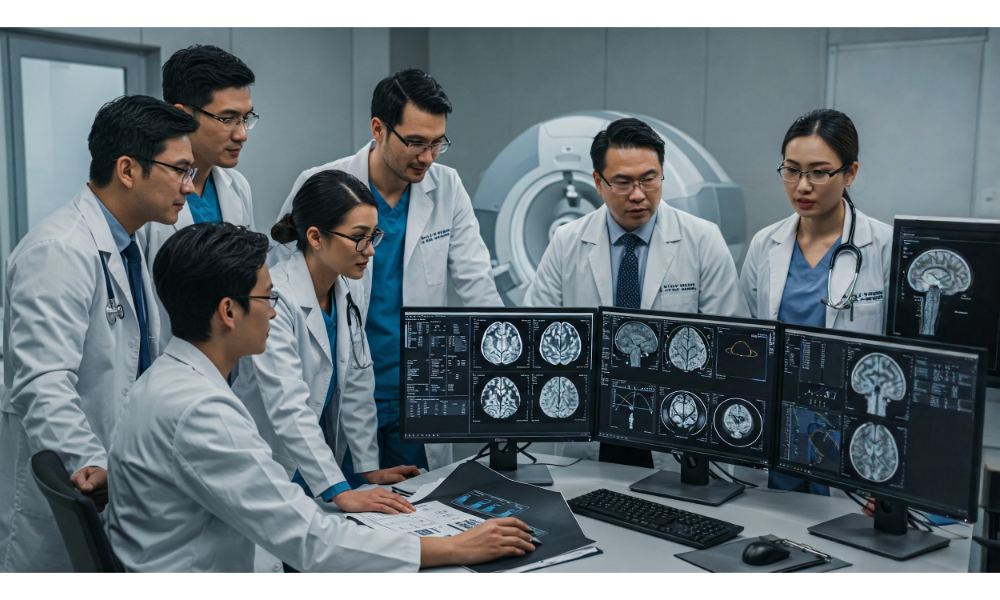
Advanced brain imaging has revolutionized the field of neurology, offering critical insights into the brain’s structure and function that were once beyond reach. While clinical evaluations and patient histories remain foundational, they often lack the detail needed for early and accurate diagnosis. Imaging technologies like MRI, CT, and PET scans now provide neurologists with the ability to detect subtle changes in brain tissue, enabling the identification of conditions such as epilepsy, multiple sclerosis, and Alzheimer’s disease at earlier stages.
Beyond diagnosis, brain imaging is invaluable for guiding treatment and tracking its effectiveness. By observing how the brain responds to therapies, doctors can fine-tune interventions to each patient’s needs, improving outcomes and reducing unwanted side effects. As a result, brain imaging enhances diagnostic precision and plays a central role in delivering personalized, effective neurological care.
Types Of Advanced Brain Imaging Techniques
The field of brain imaging continues to advance, offering a variety of techniques that together provide a comprehensive view of brain health. MRI and CT scans remain foundational—MRI excels at detecting subtle tissue changes, while CT is often used in emergencies to reveal issues like bleeding or fractures. Functional imaging methods, such as PET and fMRI, go a step further by showing how the brain works. PET highlights metabolic activity and is crucial in conditions like epilepsy, while fMRI tracks real-time brain activity, aiding in the study of complex psychiatric disorders.
Diffusion Tensor Imaging (DTI), a specialized form of MRI, maps the brain’s white matter pathways by observing water movement, making it particularly useful for assessing brain injuries and neurodegenerative diseases. By combining these imaging techniques, neurologists can obtain detailed and multidimensional insights into both brain structure and function, enabling earlier diagnosis, personalized treatment planning, and a deeper understanding of neurological conditions.
How MRI and CT Scans Revolutionized Neurology
The development of CT and MRI scans marked a breakthrough in neurology, replacing invasive and risky procedures with safer, more precise imaging. CT scans, introduced in the 1970s, enabled quick, non-invasive views of the brain, crucial for diagnosing acute issues like strokes and injuries. MRI followed in the 1980s, offering clearer images of soft tissues without radiation, making it ideal for identifying tumors, lesions, and conditions like multiple sclerosis.
These tools not only improved diagnostic accuracy but also transformed surgical planning by offering detailed brain maps that help avoid healthy tissue during operations. Beyond clinical use, MRI and CT have become essential in research and education, deepening our understanding of brain structure and disease. Their impact continues to shape modern neurology in profound ways.
The Role Of Functional Imaging In Understanding Brain Activity
Functional imaging techniques have revolutionized our understanding of the brain’s inner workings. Functional MRI (fMRI), which tracks changes in blood flow related to neural activity, provides real-time insights into how different brain regions interact during tasks such as memory, attention, and perception.
Clinically, fMRI is vital for surgical planning, particularly in cases involving epilepsy or brain tumors. It helps map critical areas of the brain—such as those responsible for speech and movement—enabling surgeons to operate with greater precision and minimize the risk of impairing essential functions. Facilities such as Kimball Health Services use this technology to assist in diagnosing and managing complex neurological conditions, including migraines, seizures, and epilepsy, where understanding brain activity patterns is essential to effective care.
In the field of mental health, functional imaging has revealed how disorders such as depression, anxiety, and schizophrenia are linked to disruptions in brain connectivity. These insights are paving the way for more targeted and effective treatments, offering hope for significant advancements in personalized psychiatric care.
Challenges And Limitations Of Brain Imaging
Despite tremendous progress in brain imaging, several challenges remain. Accessibility is a major issue—advanced scans like MRI and PET are costly and not always available, especially in low-resource areas, leading to unequal healthcare outcomes.
Interpreting brain images also poses difficulties. Accurate diagnosis depends on expert analysis, and even skilled professionals can face variability or encounter incidental findings that may prompt unnecessary concern or treatment.
Technically, no single method captures the full picture. MRI shows structural detail but lacks molecular insights, while PET reveals metabolic activity but with lower resolution. Functional imaging, like fMRI, struggles to capture rapid brain changes. These gaps emphasize the need for ongoing innovation and better integration of imaging tools.
Future Innovations In Brain Imaging Technology
The future of brain imaging is rapidly advancing, with innovations focused on higher resolution, faster scans, and greater accessibility. Ultra-high-field MRI offers exceptional detail, potentially revealing abnormalities earlier than ever before. Hybrid systems like PET/MRI combine structural and metabolic data for a more complete view of brain health, improving diagnostic accuracy. Meanwhile, AI and machine learning are transforming image analysis by detecting patterns and anomalies quickly and precisely, supporting more personalized and effective treatments. Together, these advancements are shaping a new era in neurology.
The Impact Of Advanced Imaging On Patient Care
Advances in neuroimaging technologies have transformed patient care by enabling earlier detection and more accurate diagnoses. With a clearer understanding of the brain and nervous system, neurologists can make better-informed decisions in complex cases, often resulting in improved outcomes and reduced risks. For example, early MRI detection allows timely intervention in diseases like multiple sclerosis, while functional imaging supports more precise treatments for psychiatric conditions. Beyond individual benefits, these technologies also improve healthcare efficiency and cost-effectiveness, broadening access to high-quality neurological care for many patients.
Conclusion: The Future Of Neurology And Brain Imaging
The future of neurology will be increasingly shaped by advanced brain imaging, which continues to revolutionize diagnosis and treatment through technological innovation. These tools are enabling more precise, personalized care and deepening our understanding of brain function. As new imaging techniques emerge, they will promote collaboration among neurologists, radiologists, and researchers, driving interdisciplinary solutions to complex neurological disorders. Ultimately, continued progress in imaging offers hope for earlier detection, better treatments, and improved outcomes, moving us closer to unlocking the brain’s deepest mysteries.

Comments are closed.